The right grill can shape how your outdoor cooking space looks, functions, and fits into your lifestyle. Your decision should account for available space, cooking habits, entertaining needs, design preferences, and long-term plans.
Two popular options are a freestanding grill and a built-in gas grill. Both can deliver excellent cooking performance, but they are designed for different types of outdoor spaces.
A freestanding grill offers flexibility and mobility, while a built-in grill becomes a permanent part of an outdoor kitchen. Neither option is universally better. The right choice depends on how you plan to use your space.
Freestanding Grill vs Built-In Grill at a Glance
| Freestanding Grill |
Built-In Grill |
| Flexible and easier to reposition |
Permanently integrated into the kitchen |
| Usually requires less installation |
Requires detailed installation planning |
| Works well as a standalone station |
Ideal for custom outdoor kitchens |
| Does not require surrounding countertops |
Designed to integrate with countertops |
| Easier to relocate or replace |
Creates a seamless, finished appearance |
| Good for flexible outdoor spaces |
Suited to long-term outdoor entertaining |
What Is a Freestanding Grill?
A freestanding grill is a complete grilling unit that typically includes its own base or cart, storage, and cooking area. Unlike a built-in model, it does not need to be installed into an outdoor kitchen island or countertop.
One of its biggest advantages is flexibility. You can position the grill independently within your outdoor space and, depending on the model, move or reposition it if your needs change.
This can make a freestanding grill a practical choice for homeowners who want a dedicated cooking area without committing to a complete custom kitchen. It can also work well if you expect your backyard layout to change in the future.
The trade-off is that a freestanding grill does not offer the same level of integration as a built-in model. It remains a separate appliance rather than becoming part of the surrounding countertops, cabinetry, and kitchen design.
What Is a Built-In Grill?
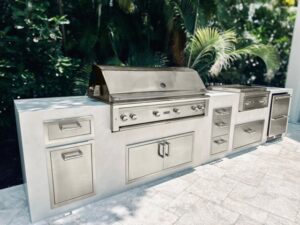
A built-in grill is designed to become part of a permanent outdoor kitchen. Instead of sitting on a standalone cart, it is installed into a custom island or cabinet structure and surrounded by countertop space.
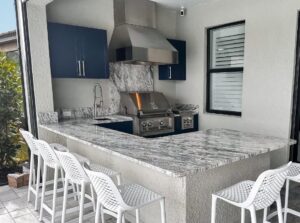
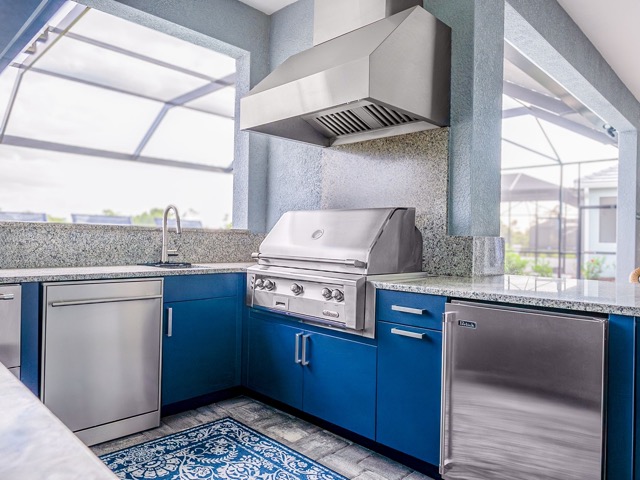
This makes a built-in grill particularly suited to a custom outdoor kitchen. The grill can become the central cooking appliance, with refrigeration, sinks, storage, side burners, and other features positioned around it.
You can explore AGH’s outdoor kitchen projects to see examples of how different grill configurations can be incorporated into custom designs.
A built-in grill is therefore more than an appliance choice. It becomes part of the overall design and functionality of the outdoor kitchen.
Design and Aesthetics
The visual difference between the two formats can be significant.
A freestanding grill has a standalone appearance. It can still look polished and sophisticated, but it remains visually separate from the rest of the outdoor space.
A built-in grill becomes part of the architecture of the kitchen. Countertops can surround the cooking area, while cabinetry and appliances can be positioned to create a cohesive workspace.
This integrated appearance can be especially valuable when you want your outdoor kitchen to feel like an extension of your home.
Countertop selection is also important. AGH offers Dekton countertops for outdoor kitchens, providing a durable surface designed for demanding outdoor environments.
Installation Requirements
Installation is another major difference.
A freestanding grill generally requires less structural planning because the appliance has its own supporting structure. However, homeowners still need to consider fuel supply, electrical requirements, clearances, and safe positioning.
A built-in grill requires more detailed planning because it needs to fit correctly within the outdoor kitchen structure. Grill dimensions, countertop depth, cabinetry, utilities, clearances, and ventilation all need to be considered before installation.
Ventilation is particularly important for built-in grills because the appliance is surrounded by the kitchen structure. AGH’s guide to built-in grill ventilation explains the importance of airflow, vent panels, heat management, and safe placement.
Planning these details early can help prevent costly modifications later.
Cooking Space and Features
The format of the grill does not automatically determine its cooking performance. What matters is the specific model, size, burner configuration, cooking surface, and features.
Consider how many people you typically cook for and how often you entertain. If you regularly host large gatherings, a larger grill with additional cooking space may be worthwhile. If you mainly cook for a smaller household, a more compact model may be more practical.
Depending on the grill, features can include infrared burners, rotisserie systems, warming racks, lighting, and multiple cooking zones.
The goal is to choose a grill based on how you actually cook rather than simply selecting the largest model available.
Flexibility and Long-Term Use
If flexibility is your priority, a freestanding grill has an advantage. Because it is not permanently integrated into an outdoor kitchen, it can generally be repositioned more easily.
This can be useful if you expect your outdoor space to change or want the option to move the grill later.
A built-in grill takes a more permanent approach. Once installed, it becomes part of the outdoor kitchen. Moving it later could require changes to countertops, cabinetry, utilities, and surrounding structures.
That permanence can be an advantage for homeowners who are committed to creating a dedicated outdoor kitchen. When the kitchen is designed around the grill from the beginning, the cooking area can be both efficient and visually cohesive.
Which Grill Is Better for Your Outdoor Space?
The right choice depends on your priorities.
A freestanding grill may be the better option if you want:
- Greater flexibility and mobility
- A standalone outdoor cooking station
- Less extensive installation
- The ability to change your backyard layout
- A grill without committing to a permanent kitchen
A built-in grill may be the better option if you want:
- A permanent outdoor kitchen
- Integrated countertops and cabinetry
- A seamless, custom appearance
- Additional outdoor kitchen appliances
- A dedicated space for entertaining and cooking
For homeowners planning a complete custom outdoor kitchen, a built-in grill is particularly worth considering because the entire space can be designed around the appliance.
Choose the Right Grill With AGH
There is no universal winner in the freestanding grill vs built-in grill debate. Your choice should reflect how you cook, entertain, and plan to use your outdoor space.
A freestanding grill provides flexibility and can be an excellent standalone cooking solution. A built-in grill is particularly well suited to a permanent custom outdoor kitchen where the grill, countertops, storage, and appliances are designed as one cohesive space.
American Grill & Hearth can help you compare grill options based on your space, cooking requirements, design goals, and long-term plans.
Contact us today to explore your grill options and start planning your outdoor cooking space with AGH.